

Relationship Marketing: What It Is and Why It Works Better Than Chasing Every New Lead

Paid ads keep getting more expensive. Content takes more time to produce and still doesn’t guarantee a client. If you’ve felt like your marketing budget is working harder than ever just to stay flat, you’re not imagining it. And the businesses that seem to be growing steadily, without constantly chasing the next lead, are usually doing something different. They’re not marketing harder. They’re marketing through relationships.
That approach has a name: relationship marketing. It isn’t a mindset or a personality trait some people happen to have. It’s a specific, learnable strategy, and it’s worth understanding on its own terms.
What Is Relationship Marketing?
Relationship marketing is a strategy built around long-term trust rather than one-time conversion. Instead of optimizing for a single sale, it prioritizes the full value of a customer or client relationship over time, along with everything that relationship can lead to: repeat business, referrals, and advocacy.
Where traditional marketing asks “how do I get this person to buy today,” relationship marketing asks “how do I build something worth returning to.” That’s a different question, and it changes almost everything about how you show up: how you follow up, how you communicate, and how much you invest in people who aren’t ready to buy yet.
Relationship Marketing vs. Transactional Marketing
Transactional marketing is built for speed. Ads, promotions, and cold outreach are all designed to move someone from stranger to customer as quickly as possible. It can work, but it usually requires constant investment to keep working. Stop spending, and the leads stop coming.
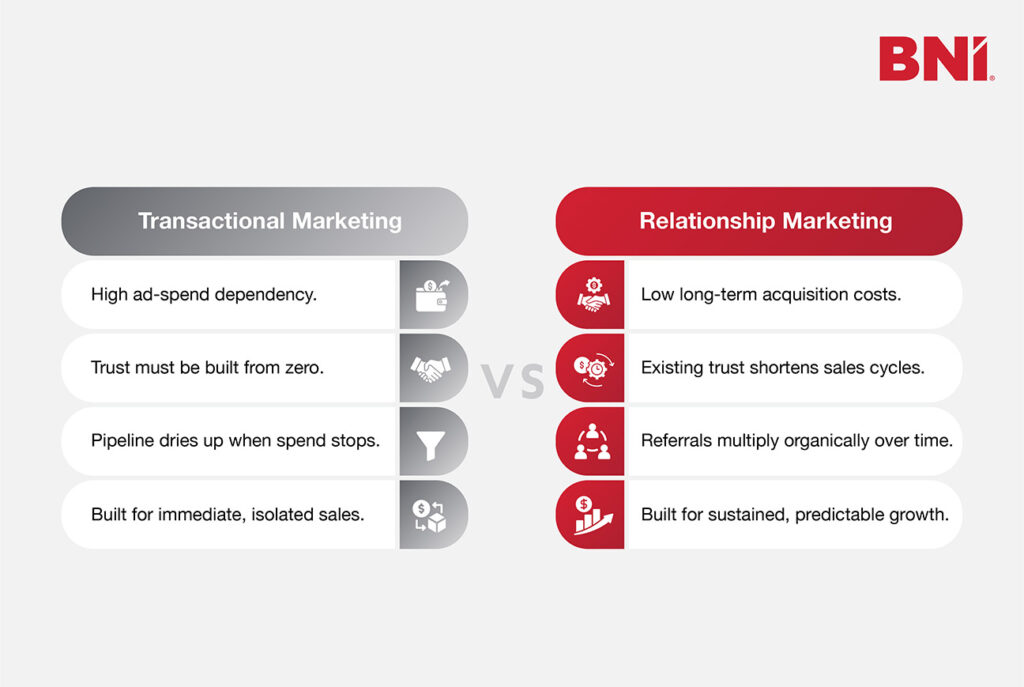
Relationship marketing works on a different timeline. It costs more upfront in time and attention, but it costs less to sustain over the long run. A strong relationship doesn’t just retain one customer. It often brings you new ones through referral, at a fraction of the cost of acquiring them any other way.
See why 355K+ entrepreneurs choose BNI
Get InvitedWhat Relationship Marketing Looks Like in Practice
Relationship marketing isn’t abstract. It shows up in specific, repeatable behaviors:
- Following up consistently, not just when you need something
- Personalizing communication instead of treating every client the same way
- Staying visible in your network over time, rather than reintroducing yourself from scratch
- Actively building referral partnerships with other professionals who serve your same clients. This is essentially the structure BNI chapters are built around: a group of professionals who deliberately learn each other’s businesses well enough to refer with confidence
- Keeping track of what people actually tell you, so following up later shows you were listening
Is relationship marketing the same as referral marketing?
Not exactly. Referral marketing is one output of relationship marketing, not the whole strategy. Referrals happen because trust already exists. Relationship marketing is the broader practice of building that trust in the first place, through consistency, communication, and genuine investment in the people around you.
Why Relationship Marketing Drives Longer-Term Growth
The economics matter here, and they hold up from a few different angles.
Retaining a client is almost always less expensive than acquiring a new one, since there’s no need to rebuild trust from zero. A business built on relationships spends less time and money starting over with every new client.
Trust also shortens the sales cycle. When someone already knows and trusts you, or trusts someone who’s vouching for you, the usual friction of a first conversation disappears. There’s less convincing to do because the credibility work already happened.
And referrals scale differently than paid channels. A strong referral relationship compounds: one good connection leads to an introduction, which leads to another relationship, which generates another referral. Unlike ad spend, where costs tend to climb as competition increases, the cost of a referral-driven client often gets lower over time as your network deepens.
Businesses that lean into relationship marketing tend to grow more predictably as a result. Instead of a pipeline that spikes and dries up based on how much you’re currently spending, growth becomes a byproduct of relationships that are already in motion.
How to Start Practicing Relationship Marketing
The good news is that relationship marketing doesn’t require a bigger budget. It requires structure.
Start by showing up consistently in the same places, with the same people, instead of spreading yourself across a new event or platform every week. Prioritize the quality of the experience you deliver, since that’s what earns the kind of trust people talk about. Build referral partnerships deliberately with professionals who serve a similar client base to yours, rather than waiting for those relationships to form on their own. And keep track of the relationships themselves, not just the leads they produce. Following up on something someone mentioned months ago signals that you were actually paying attention.
That last part is exactly where most people get stuck. It’s easy to know relationship marketing works and still have no structure for actually doing it consistently.
This is the gap BNI was built to close. Rather than leaving relationship-building to chance, BNI gives business professionals a weekly, structured environment where those relationships form on purpose. Members get to know each other’s businesses deeply enough to refer with confidence, and because the group meets consistently, trust has room to build week over week instead of resetting every time you meet someone new. It turns relationship marketing from something you hope happens into something you can actually count on.
Relationship Marketing Is a Strategy, Not a Stroke of Luck