

What Is a Referral? And Why the Definition Matters to Your Business

Most business owners will tell you they get a lot of their new clients through referrals. And most of them are right. Sort of.
The problem is that the word referral gets used to describe a wide range of interactions. Someone mentions your name at a networking event. A former client shares your contact information. A colleague offers to make an introduction. A prospect reaches out after hearing great things about your work. Those situations often get grouped together, but they aren’t all the same thing.
Understanding the difference isn’t just a matter of terminology. Different types of recommendations create different levels of trust, intent, and opportunity. If you’ve built any part of your business development strategy around referrals, it’s worth asking a sharper question: What kind of referrals are you actually getting?
What Does Referral Mean in Business?
A business referral is more than someone mentioning your name. It’s a recommendation or introduction that connects you with a qualified prospect who has a genuine need for what you offer. The trust established by the person making the referral gives you a stronger starting point than a cold lead or unsolicited outreach.
The reason this definition matters is because “referral” is one of the most frequently used (and most inconsistently understood) words in business networking. Depending on who you ask, it might describe a casual mention, an introduction over email, or a prospect who is already ready to have a conversation. Those interactions all have value, but they don’t all create the same business opportunity.
If you can’t clearly define what you’re trying to generate, it’s difficult to build a reliable referral strategy. You can’t measure it, improve it, or ask for it in a way that consistently produces better results.
Experience referral networking in action
Get InvitedBusiness Referral vs. Recommendation vs. Word of Mouth Referral
Not all word-of-mouth business works the same way. There’s a meaningful spectrum, and where your referrals fall on it determines how much selling you still have to do once the connection is made.
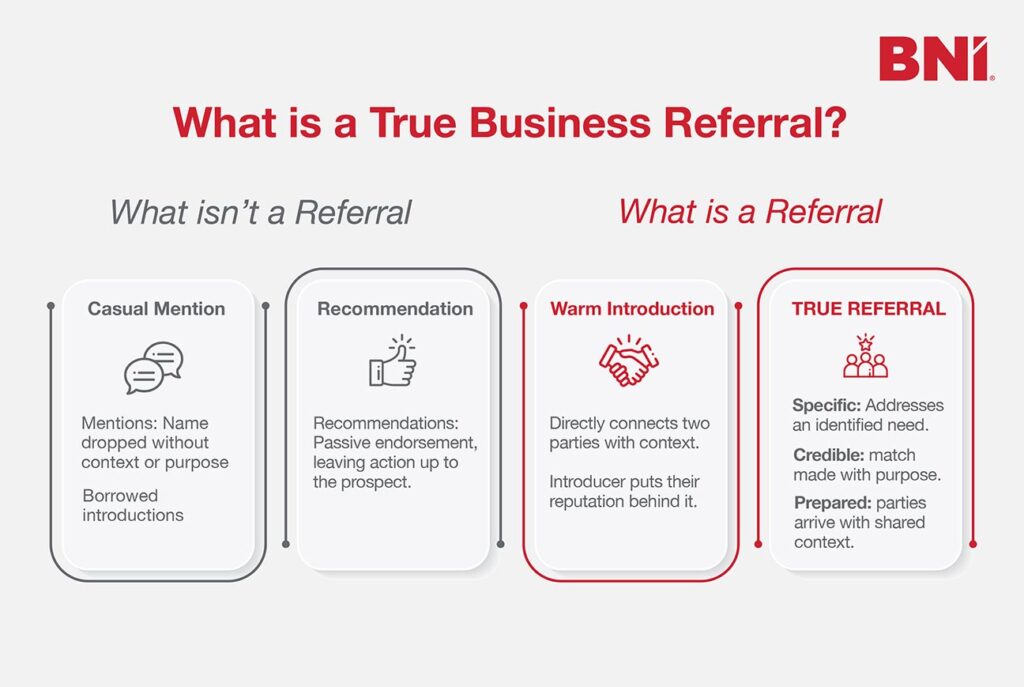
What is a casual mention?
A casual mention is when someone brings up your name in passing, with no context, no follow-through, and no warmth. If nothing follows, it evaporates. These show up in business conversations constantly, and they’re worth almost nothing on their own. The person on the receiving end has no more reason to trust you than they would a cold search result.
What’s the difference between a recommendation and a referral?
A recommendation goes a step further than a mention. Someone actively endorses you based on their own experience — they’ve worked with you, they know your work, and they’re willing to say so. That creates real credibility. But a recommendation can still stop short of connecting the two parties directly. The prospect is left to decide what happens next, which means a lot of them don’t do anything at all.
What is a warm introduction?
A warm introduction connects two people directly — an email, a facilitating conversation, a direct connection made with some context attached. The introducer is putting their own reputation behind the connection, which carries meaningfully more weight than a recommendation made in passing. Warm introductions often open doors that are difficult to reach through traditional outreach.
What makes a true referral different?
A true referral is specific, credible, and prepared on both ends. The referrer has identified a specific need, recognized the match, and made the connection with purpose. Not “you should talk sometime,” but “I know someone who can help you with exactly this.” They’ve shared enough context that their contact arrives expecting to work with you, and they’ve prepared you with information about who you’re connecting with and why.
This is what’s sometimes called credibility transfer. The trust someone has built with the referrer extends to you before you’ve said a word. The prospect isn’t evaluating you from scratch. They’re already leaning in. The result is a dramatically shorter sales cycle, because the trust work is already done.
It’s exactly the environment BNI is structured to create. Members meet weekly, get to know each other’s work in depth, and operate under a shared expectation that referrals are passed at this standard, not as casual mentions, but as specific, credible, prepared connections.
Why Getting the Referral Definition Right Grows Your Business
When you treat a mention like a referral, you lose the ability to diagnose why your referral strategy isn’t working. You can’t improve something you’re mismeasuring.
Business owners who get precise about what a referral actually is tend to do three things differently: they ask for referrals more specifically, they receive them more reliably, and they reciprocate in ways that deepen the relationship rather than just fulfilling a social obligation.
There’s also a compounding effect. When you start giving true referrals, and when those are specific, credible, and prepared, you start receiving them at the same standard. Referral quality, like trust, builds on itself.
BNI members are trained to pass referrals at this standard. That’s not incidental to the model. It’s central to it. The organization has tracked referral activity at a scale that very few professional communities can match, and the results reflect what’s possible when everyone in the room agrees on what a referral actually means.
How to Get More Business Referrals