

How to Grow a Small Business When Your Content Strategy Has Hit a Ceiling

Growing a small business past the freelance or side hustle stage is one of those transitions that sneaks up on you. The income is consistent, the portfolio is strong, and the content is doing its job. So why does growth feel like it’s stalled?
Your strategy isn’t broken. It’s finished. The tools that got you here did exactly what they were supposed to do. They built visibility. And visibility, past a certain point, plateaus.
This is one of the more disorienting moments in early business-building, because nothing feels obviously wrong. The plateau doesn’t show up as failure. It shows up as another month that looks almost identical to the last one.
What comes next requires a different approach, and it’s probably not what you’d expect.
What a Growth Plateau Actually Means
There’s an important distinction here: a strategy that’s failing looks different from one that’s maxed out. Failing means it isn’t working. Maxed out means it worked, and now it’s done most of what it can do.
For freelancers and small business owners, the plateau usually follows a familiar pattern. Income is steady but flat. New clients are still coming in, but from the same two or three sources. Referrals happen occasionally, but by accident rather than by design.
That last part is the most telling. Accidental referrals mean your reputation is working but your network isn’t. The next stage of small business growth is building a structure where referrals happen more often, for more people, on purpose. Grinding harder at what’s already maxed out won’t change that.
Why More Content Isn’t the Answer
The instinct for most content-native entrepreneurs is to produce more. Better posts, more platforms, bigger reach. It makes sense because that’s what worked before.
But content builds awareness, not trust. And awareness has real diminishing returns. Algorithms shift. Audiences are borrowed, not owned. Even engaged followers don’t convert the way a warm introduction does.
There’s also a structural ceiling to what broadcasting can achieve. Reaching thousands of strangers is genuinely valuable early on. Over time, the effort required to convert cold attention into paying clients stays high while the return per conversion often stays low.
The shift that defines the next stage isn’t about output. It’s about moving from broadcasting to connecting, from reaching people who don’t know you to building real relationships with the ones who do.
See why 355K+ entrepreneurs choose BNI
Get InvitedWhy Referrals Beat Cold Outreach for Business Growth
A warm introduction does something no piece of content can: it transfers trust.
When someone a prospect already trusts says “you need to talk to this person,” the whole evaluation process compresses. Credibility is already established. The conversation starts differently and closes faster.
Most established businesses trace their best long-term clients back to a referral, not a cold channel. That’s not a coincidence. It’s how trust actually travels, person to person, relationship to relationship.
The entrepreneurs who break through the plateau aren’t always creating better content. They’re getting introduced to the right people consistently, because they’ve built relationships where those introductions happen by design. Referrals can be structured. That’s the insight that changes things.
How to Build a Network That Generates Business
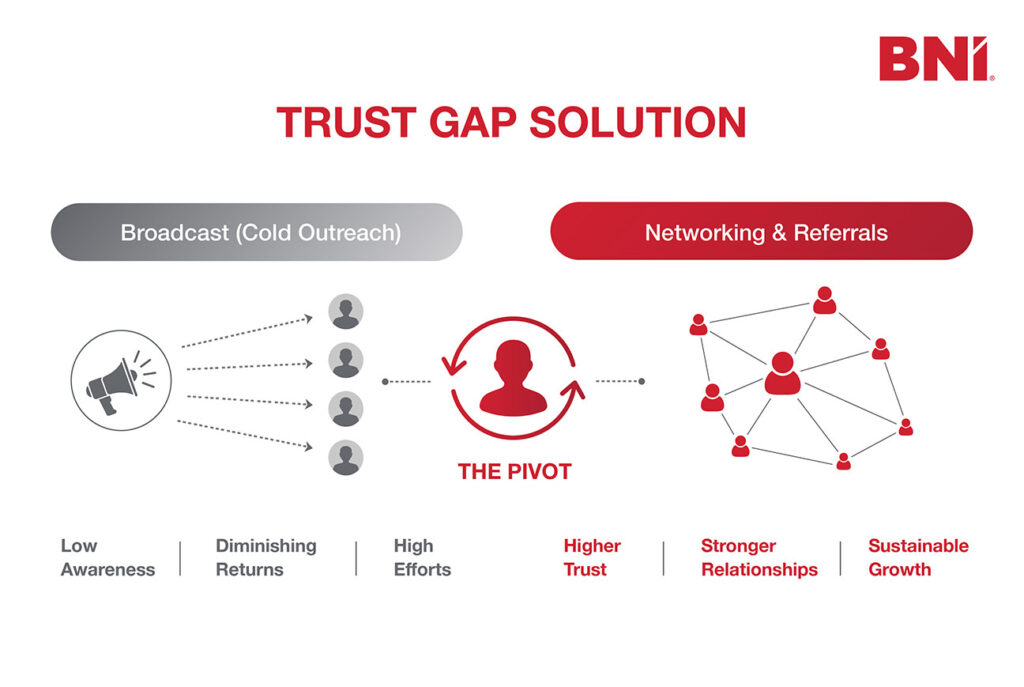
Scaling a solo business requires infrastructure. Most early-stage thinking goes toward platforms, tools, and systems. But people are infrastructure too, and often the most effective kind.
In practice, a strong referral network looks like a trusted group of professionals who actively think of you when the right opportunity comes up. Not because they happen to remember your name, but because the relationship is active enough that you stay top of mind.
That’s exactly the problem BNI was built to solve. Members meet weekly, share what they’re working on, and pass referrals as a standard part of how the group runs. Over time, people in your chapter learn your business well enough to spot opportunities for you in conversations you weren’t even part of.
The consistency built into that structure matters as much as the meetings themselves. Relationships that aren’t maintained go cold. A system that keeps them active, regularly and predictably, solves a problem most freelancers don’t realize they have until the referrals stop showing up.
The Real Next Step for Growing Your Business