
Build a Network That Refers You

Business networking doesn’t build a referral pipeline by accident. It moves through a rough sequence, whether people realize it or not: you build a relationship, help that person understand what you do, give them a reason to act on your behalf, and eventually, ask. Skip a step or do them out of order, and the whole thing tends to stall.
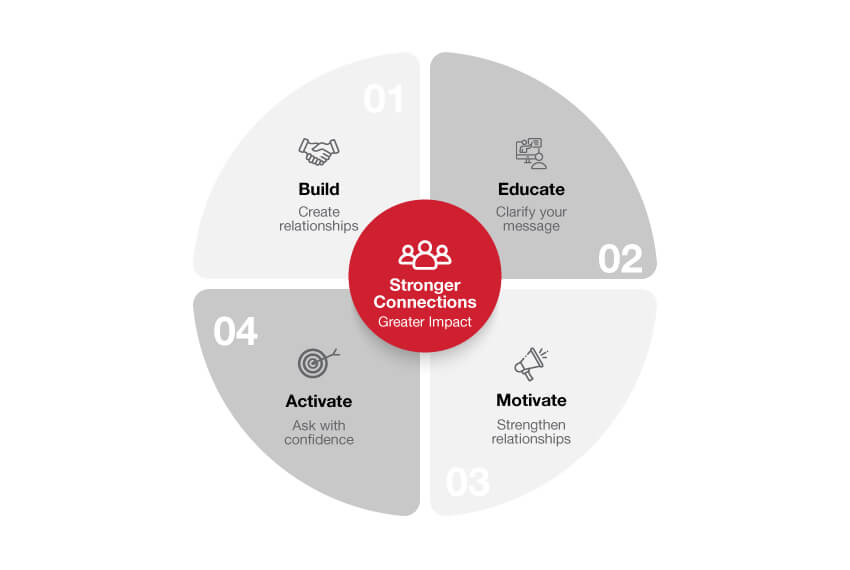
That sequence has a name worth knowing: build, educate, motivate, activate. It’s simple on paper, but most people rush past one or two of the steps without noticing, which is usually why their network isn’t producing what they expect.
Build Your Network With Intention
Everything starts with building the relationship itself.
Every person you meet has some potential role in your professional world, even if that role isn’t obvious right away. The mistake most people make is evaluating a new connection purely on whether that person might buy something soon. That’s a transactional read on networking, and it closes off most of what makes a network valuable.
Effective networkers lead with curiosity instead. They take time to understand who someone is and how they think before deciding what that person might mean for their business. Some of the most useful professional networking tips come down to this one shift: are you meeting new people, or spending the whole time with the same familiar faces? Growth happens when you stretch past who you already know.
Educate Your Network Clearly
Once a relationship exists, the next step is making sure people understand your business well enough to refer you.
This sounds obvious, but plenty of professionals struggle to describe what they do in a way that’s simple and memorable. Your message needs to do more than describe your work. It needs to help someone else recognize an opportunity to send you a referral, even when you’re not in the room.
A few questions worth asking yourself: Is your message simple enough for someone else to repeat with confidence? Does it make clear who you serve and how? Does it help people spot the moment to connect you with someone? The clearer the message, the easier the introduction, and the more likely it is to happen.
This is part of what BNI’s weekly presentations are built for. They give Members repeated practice turning “here’s what I do” into something a referral partner can act on.
See why 355K+ entrepreneurs choose BNI
Get InvitedMotivate Through Relationships, Not Pressure
Understanding your business isn’t enough on its own. People also need a reason to act.
That motivation comes from the relationship, not from pressure. When someone feels genuinely appreciated and connected to you, they’re far more likely to advocate for you without being asked. Shared experiences help here, whether that’s a small gathering, an event, or a deliberate introduction between two people who’d benefit from knowing each other.
Follow-up matters just as much. Checking in, expressing genuine gratitude, and staying curious about what your referral partners are working toward keeps a relationship active instead of letting it go cold. This is really an extension of why trust drives long-term growth: motivation isn’t something you request, it’s something you earn by consistently showing up for the other person first.: motivation isn’t something you request, it’s something you earn by consistently showing up for the other person first.
Activate Your Network With Confidence
The final step is where most people hesitate: asking for the referral or introduction.
If the earlier steps were done well, activation tends to feel like a natural next move rather than an awkward ask. And if it doesn’t, that’s useful information rather than a failure. If people seem unsure how to help you, that usually points back to a gap in how clearly you’ve educated them. If they hesitate to act, that often reflects a relationship that hasn’t built enough trust yet. It’s one of several common networking mistakes worth watching for, since skipping the ask is easy to do without noticing.
Not everyone in your network will become an active referral source, and that’s fine. Some people will be strong connectors. Others will play a different role entirely. The goal is investing time where there’s mutual value, not treating every relationship the same way.
Building a Network That Works for You
Networking isn’t a single action. It’s a sequence: build the relationship, educate people on your value, motivate them through genuine connection, then activate what you’ve built.
Done in order, something shifts. You stop having to sell to your network, because your network starts carrying your message for you. This is close to what BNI Chapters are structured around: a consistent group of people who already understand each other’s businesses well enough to activate referrals without a hard ask.
The strength of a network was never about how many people are in it. It’s about how well those relationships are built, informed, and engaged.
For business owners who want a structured environment to practice all four steps consistently, visiting a local BNI Chapter is a good place to start.