

Business Development Strategies That Compound Over Time

Business development gets treated as a department, a job title, or a line item on an organizational chart. Rarely as a habit. That’s the gap that keeps it from actually working for a lot of companies. It’s easy to assign someone the role. It’s harder to build the ongoing practice that role is supposed to represent.
At BNI, the phrase comes up constantly, mostly because the organization is built around one specific approach to it: relationships that generate business consistently, rather than sales pushes that generate it occasionally.
What Business Development Means
Business development is the set of activities that create long-term value for a company by building relationships, partnerships, and market position. It’s related to sales and marketing, but it’s not the same as either one.
Sales is about closing a specific deal. Marketing is about generating awareness and interest. Business development is the layer underneath both of those, the ongoing work of building the relationships and positioning that make sales and marketing more effective in the first place.
Experience referral networking in action
Get InvitedCommon Business Development Strategies
Most businesses use several business development strategies rather than relying on just one.
Strategic partnerships connect a business with other companies that serve a similar audience without competing directly, so both sides benefit from referring clients to each other.
Content and thought leadership build credibility over time by demonstrating expertise publicly, which makes prospects more comfortable reaching out.
Direct outreach involves proactively contacting potential clients or partners, whether through cold email, calls, or in-person introductions.
Referral networks rely on trusted relationships to generate warm introductions instead of cold ones. This is the strategy BNI formalizes into a weekly practice rather than leaving it to occasional coffee meetings.
Each of these can work. But they don’t all work the same way, and they don’t all compound the same way either.
Experience referral networking in action
Get InvitedWhy Relationship-Based Strategies Work Better
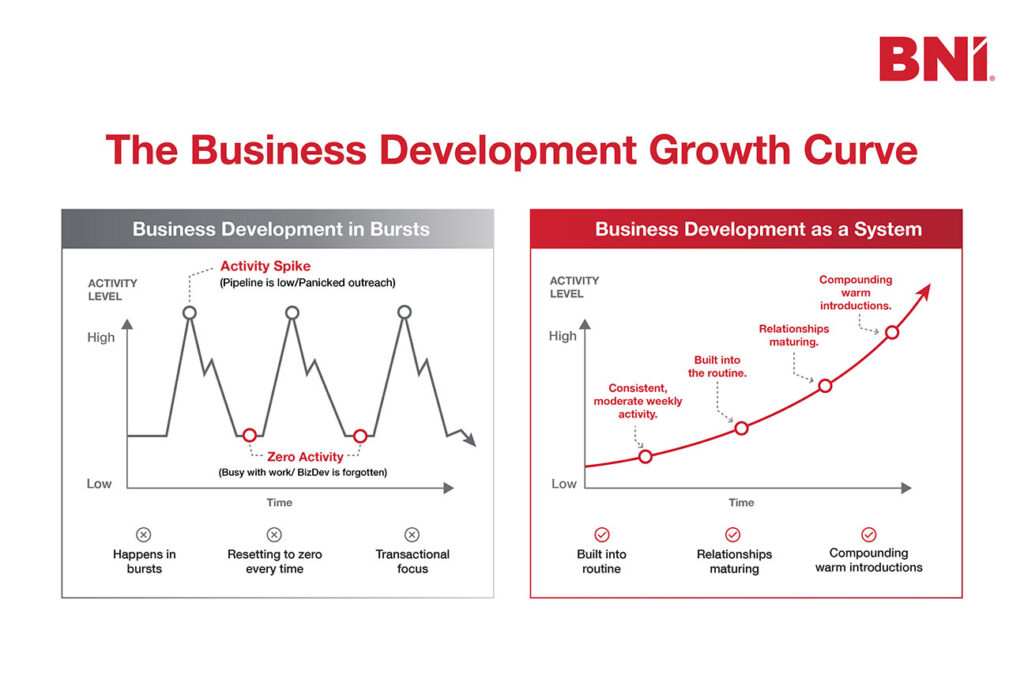
Cold outreach and one-time campaigns tend to reset. Every new prospect starts from zero, with no context and no familiarity to build on. That means every conversion requires convincing someone from scratch.
Relationship-based strategies work differently. Credibility carries over from the person making the introduction to the person receiving it, which means the sales cycle starts further along than it would with a cold lead. And unlike a single campaign, a relationship keeps producing value over time. A strong partnership or referral connection doesn’t expire after one deal. It tends to generate more opportunities the longer it’s maintained.
This is also why relationship marketing and business development overlap so much in practice. Both are built on the idea that long-term relationships outperform short-term transactions.
Turning Business Development Into a System
The businesses that get the most out of business development don’t treat it as a one-time initiative. They build it into a routine.
That usually means setting aside consistent time for relationship-building activities, not just when the pipeline is slow. It means being specific about the kind of partnerships or introductions that would actually move the business forward, rather than networking broadly and hoping something useful comes out of it. And it means following through and staying in touch with the relationships already in motion, rather than letting them fade after the first conversation.
Without that structure, business development tends to happen in bursts: a flurry of outreach when things feel slow, followed by long stretches of nothing. A weekly structure, the kind BNI is built around, keeps it running steadily instead.
How BNI Supports Business Development
This is close to what BNI was built to provide. Members meet weekly with a group of professionals from different industries, which gives each person a built-in network of potential referral partners without the awkwardness of internal competition, since each Chapter includes only one professional per specialty.
Over time, those relationships become one of the more reliable business development channels a company can have. Instead of chasing new partnerships from scratch every quarter, Members build a network that keeps generating warm introductions on an ongoing basis.
It’s not a replacement for other business development strategies. It’s infrastructure for the relationship-based ones, the kind that tend to compound the most.
One Relationship at a Time