

Networking in a New City: How to Rebuild a Professional Network After a Move

Moving to a new city is full of small logistics: a new address, a new commute, a new grocery store. But there’s a bigger adjustment that tends to sneak up a few weeks in, once the unpacking is done and life starts to feel normal again.
You reach for your professional network, and it isn’t there.
The people who were once your automatic calls, the ones you relied on without a second thought, aren’t readily available anymore. Your network didn’t disappear. It just stopped being local.
Networking in a new city is its own kind of challenge, and it’s easy to underestimate. You can’t solve it the way you solved everything else on the moving checklist. But you also don’t have to start from zero. With the right structure, you can rebuild those local relationships more intentionally than you might expect.
What a Move Costs You Professionally
A move changes more than your address. It changes who you can call.
Think about what your old network actually did for you. Referrals and opportunities could come through people who already knew your work. You had vendors you counted on because you’d worked with them for years. You walked into rooms where people already knew your reputation. And when something came up outside your wheelhouse, you knew exactly who to call.
Those relationships still exist after a move, but they no longer provide the same day-to-day local network.
The people this catches most off guard are often the ones who were the most connected before. They built those relationships so gradually that they may not have noticed how much professional infrastructure had formed around them until they were suddenly operating without it nearby.
Why Waiting for a Network to Rebuild Itself Doesn’t Work
The natural instinct is to treat this like starting a new job: update your profile, attend a few events, introduce yourself around, and expect relationships to build over time.
But a referral only happens when someone believes in you enough to put their own name behind yours. That kind of confidence doesn’t come from a polished profile or one good conversation. It comes from repeated contact and enough experience with someone to understand how they work and who they can genuinely help.
The other common misstep is spreading yourself across a different event every week: a mixer here, a luncheon there. It feels productive, but every new room can mean starting over. You keep meeting people without giving many of those relationships the chance to progress beyond an introduction.
Experience referral networking in action
Get InvitedWhy Structure Beats Scattered Networking
Finding one or two groups you can actually commit to tends to work better than sampling a little bit of everything.
A better question than “Where can I meet people?” is “Where will I keep seeing the same people until I actually know them?”
Local chambers of commerce, alumni networks, industry associations, and other professional organizations can all be useful starting points. The important thing is finding an environment that creates repeated interaction rather than a constant stream of one-time introductions.
BNI Chapters operate on that principle: consistent meetings with the same group of professionals over time. Because Chapters exist across many markets, relocating professionals can step into an established structure rather than having to create a referral community from scratch. The structure doesn’t guarantee results on its own, but it gives real relationships far more chances to form than scattered, one-off networking does.
Rebuilding Your Referral Relationships
Referral relationships are often the hardest to rebuild because someone has to be willing to put their own reputation behind a recommendation.
Think about the industries you used to lean on most, the professionals you relied on because you’d seen how they worked over time. It helps to think ahead about who you’ll need before you’re actually scrambling for them, so you’re building those relationships before the need becomes urgent.
BNI’s one-profession-per-Chapter structure can make that process more intentional. Instead of independently trying to find professionals across every category, you’re regularly meeting people representing different businesses and specialties. Over time, you learn how they work, who they serve best, and who you’d eventually feel comfortable recommending. That kind of confidence needs repeated interaction to grow, not a single good conversation.
What a Realistic Timeline Looks Like
Even doing everything right, this takes months, not weeks. That’s normal.
Early on, progress can look small. People start remembering your name. Someone invites you to something you weren’t part of before. A local professional asks for your opinion. A small referral comes through. Those moments are signs that familiarity is starting to turn into something more.
Give a group real time before deciding whether it’s working. One visit rarely tells you much. It’s the relationships that build over several visits that show you whether you’ve found a professional community worth investing in.
Consistency matters here. When each interaction builds on the last, you’re no longer introducing yourself over and over. You’re building a reputation.
Where to Start Networking in a New City
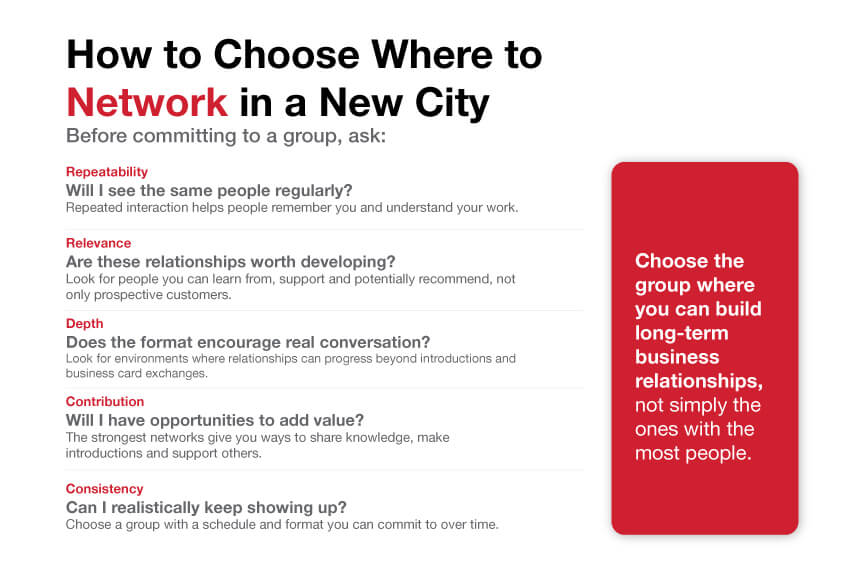
Pick two or three groups that seem worth trying, and give them real consistency instead of spreading yourself thin. Pay attention not only to how many people you meet, but whether you’re having better conversations with the same people over time.
Your old network still counts for something, too. It came with you. This isn’t about replacing it. It’s about building alongside it in a new place.