Submitted by Justin Brande, BNI Vermont Director Consultant
When was the last time you attended a Member Success Program session? Did you have a favorite lesson from the course?
Every time I attend or teach Member Success Program, my favorite part is always the Referral Confidence Curve. This important lesson encourages us to make wise decisions and practice wise behaviors in all of our interactions with others, BNI-related and not. When we do something wise and other BNI Members witness it, their confidence in us goes up. The more confidence in us they have, the more likely they are to send us better and better referrals.
It reminds me of something that pops up on the internet every so often: “Would a foolish person do this?” Would a foolish person jump off a bridge into a river without checking if it is safe to do so? If we ask ourselves that question about any action we are considering taking, and the answer seems to be yes, then maybe we should think twice.
Let’s use that same framework to create a question specific to the Referral Confidence Curve. “Would a BNI Member trying to increase others’ confidence in them [insert the following]?”
Would a BNI Member trying to increase others’ confidence in them use their smartphone during their meeting? Nope.
Would a BNI Member trying to increase others’ confidence in them skip a One-to-One? Certainly not.
Would a BNI Member trying to increase others’ confidence in them treat a customer or another member disrespectfully? Absolutely not!
Ask yourself that question about anything you do or don’t do in BNI.
Climbing the Referral Confidence Curve is easy, it just takes time. Crashing back down to the bottom of the Curve is even easier. It can happen with enough small poor choices, or even happen in a single instant if the poor choice is severe enough.
It may seem like the goal of climbing the Curve is just to get more referrals (and that is often one of the outcomes), but it’s more about the behaviors that come before that. Let’s make good decisions in our life, and let’s make good decisions in BNI. Not because we expect reward, but because it’s the right thing to do.
Can you believe this year?s Global Convention is only five months away? ?Below are the top three things you need to know about this year?s event, which is centered around how you can build a A New World of Opportunity in BNI:
This is an excellent opportunity to promote your business to BNI Members and Director from around the world. One hundred individuals will have the opportunity to promote their business, and showcase their products and services, to a truly global audience at our first ever trade show. Register here to reserve your exhibit booth. Unique sponsorship opportunities are also available.
Guests are invited! On Wednesday, 7 November, your friends, business colleagues and partners are invited to join us at the Centara Grand & Bangkok Convention Centre at CentralWorld to network, share ideas and meet the BNI leadership team.
We hope you, your family and your colleagues join us in Bangkok for #BNIGC18. Have any questions? Email events@bni.com. We?re here to help you get the most out of your experience.
Submitted by Braith Bamkin, Executive Director – BNI Melbourne West & Geelong and Melbourne Central
In a previous post, I discussed the concept of owning a ‘BNI share’ rather than buying a membership. I talked about how shareholders in BNI can do simple things to increase the ‘yield’ of their share and I discussed how you can do simple activities to generate tens, hundreds or thousands of times returns on your investment.
This week, I want to talk about how you can increase the capital growth of your share.
If you buy a share on the stock market, you want to see it increase in value over time. The same should be said for your BNI share. Increasing capital growth is really easy in BNI if you follow these simple guidelines.
Each time your chapter lets another member join, you are effectively splitting your share. Unlike normal shares, this increases the value of your original shareholding. It’s possibly counterintuitive to those outside of BNI, but listen to this podcast from Dr Misner and you’ll learn just how powerful large chapters can be and he back sit up with hard stats.
Be careful who you let into your chapter.
Not everyone is right for BNI and BNI certainly isn’t the best marketing tool for many. If you have new people join your chapter, you want to ensure they understand the commitment required by being in a BNI chapter. Just like any shareholding, your BNI share comes with certain responsibilities and expectations. Quality members are the goal of every chapter.
Dr Misner, founder of BNI discusses the concept of “Who’s in your Room” in this informative podcast.
Ensure there are people looking after your best interests.
If you have stocks, you probably have a stockbroker or investment advisor. He or she is charged with looking after your investments and making sure you are protected. In BNI we have a similar function, we call it the Membership Committee. They are there to ensure your BNI share increases in value.
Being on the membership committee is a great way to serve your fellow members and those that take this task seriously, ensure everyone benefits from having the right people in the room.
Listen to this podcast from BNI founder, Dr Ivan Misner on the ‘function’ of your membership committee.
Measure and track
Like any share, you want to measure and track the results. BNI has many tools that help you to measure and track your investment and also those of other ‘shareholders’ in your chapter. Many regions use the Power of One reports. Some regions use the member commitment report. Either way, you have valuable tools on hand that help you to manage your BNI share.
I really like the Power of One report (traffic lights) because this easily shows al members what activities they need to do to meet the minimum expectations of the chapter. As discussed last week, these basic activities combined will deliver a strong yield which over tie will increase the overall value of your share.
Approach your membership like buying a share and your behaviours and activities in BNI will definitely change. You’ll spend more time doing the basics and ensure that the overall health of your chapter is maintained.
We don’t teach networking in colleges and universities hardly anywhere in the world — we didn’t when I went to school, and we still don’t today. I meet so many entrepreneurs who are hungry to learn how to network effectively. Many things about networking are actually counter-intuitive to what business people may actually think. So – how do entrepreneurs learn? Other than through trial and error, I recommend finding someone who can mentor you on how to network effectively.
Recently, I had someone ask me four questions about this process. Here are the questions and my answers to them.
1. Who should your mentors be, and how do you find them?
First you need to determine your values (they can be aspirational values – values that you are striving to achieve), or they can be values that are clearly part of your life now. Next, you need to think about your personal and professional goals. Have you noticed that many successful people tell people to set goals? There’s a good reason for it – they work! So think about yours before you look for a mentor. Once you’ve looked at your values and thought about your goals, then, look for people that you believe embody those values and goals. Try to “network up.” Look for successful people whom you admire, who embody values congruent with yours, and who may be able to help you with your objectives. Look for people who have the characteristics that represent your values, who may have achieved some of the same kind of goals that you have established, and then go to the places where you can actually have meaningful conversations with these prospective mentors. Unless you pay for coaching, trying to get the “sage from the stage” to be your mentor may not be realistic and will definitely not be easy. Talk to people you’ve met, know, and respect. They are the most likely candidates.
2. Should the relationship be formal or informal?
It is not either/or, it is both/and. Both can work. I have had many, many informal mentoring relationships, as well as formal ones. I’d recommend creating a formal mentoring relationship for about a year (if the prospective mentor is willing), then let it transition to something more casual over time. If the mentor is only available informally, go with that. The “right” person is the key. Work with this person as much as is reasonable and respectful of their time.
3. What should you expect from your mentor, and what should they expect from you?
It depends on whether your relationship is formal or informal. In both cases, you want the relationship to be congruent with your values and goals. It always comes down to that. Formal relationships should have structure and processes in place. They should include regular meetings in person or by Skype (generally monthly). There should be a set objective or topic to discuss at each of these sessions. I have found it helpful if the person I’m mentoring sends me questions in advance so I can give thought to them before we talk.
4. How do you both determine whether the relationship is working and also recognize when it is time to move on?
As long as you continue to receive value from the relationship and/or give value to the relationship – it is working. I have had some mentoring relationships where I started as the mentee, but it evolved over time where I was a peer mentoring my mentor on certain issues. That’s when you know you’ve developed a long-term friendship. Ideally, a strong mentoring relationship evolves into a long-term connection and friendship.
Some people tell me they don’t have time to be a mentor. To them I say, “find a way to make the time if at all possible.” You see, every time I was a mentor to someone – it was also a learning experience for me. When I was given topics from people I mentored, I always did a little research or looked through my files to see if there was something I could offer them to help them through the issue. What I realized over time was that I was improving myself while trying to help them.
This really struck home with me when many years ago I coached my son’s elementary school chess club. I remember going into it thinking that it would be great to spend time with my son and his friends – but at no time did I think that I would become a better player by coaching 10 and 11 year olds! I soon discovered that I was wrong. By coaching these young chess enthusiasts, I had to really brush up on my game. More importantly, I had to do my homework to learn the names for many of the moves and strategies that I had done intuitively for years. I was amazed at how my game improved by coaching elementary school kids.
The same is true with mentoring people to network better. The process not only benefits the mentee, it also benefits the mentor.
Submitted by Peter Ruthenberg, BNI Intrepid, BNI South Peninsula, South Africa
I consider myself fortunate to have been invited to join a BNI core group in Cape Town before the chapter launched. I understood the benefits of being in a network group, but the deciding factor for me to sign up as a member was the structure that BNI offers, the repetitious nature of a simple-to-follow system that encourages being focused, and that members are held accountable – especially for giving good quality referrals and follow through when a referral is received.
I definitely benefited from our core group members pulling together for a common chapter launch goal, and from having the advantage of being in weekly training with a director consultant at a point where no “bad habits” might have crept into our meetings – as well as from attending Member Success Training. But, it took six months and a particular One-to-One for me to truly begin to gain the benefits of being a BNI member. About six months in I had a One-to-One with a BNI member who highly recommended listening to the BNI podcasts. I took up his recommendation and started at podcast #1. I have subsequently listened to BNI podcasts at a rate of about 15 to 20 per month and it has made a remarkable difference to my BNI membership.
From the start I have found it easy to have One-to-Ones and build relationships with my fellow members; and I take every opportunity to invite visitors, sharing with them firsthand how BNI has helped to grow my business, but that having been said, listening to podcasts, being trained by Dr. Ivan Misner, reinforcing the basics of The Power of One, and keeping my BNI goals firmly in view has made a significant difference to my membership – and I have not looked back!
I have found that BNI education comes in several forms: In being dedicated to self-education; in being continually educated regarding my fellow members’ businesses and their ideal referrals; and, as President of my chapter, in educating my fellow members by walking the talk. You first have to do what you would like other members to do – for the good of everyone in the chapter.
Submitted by Donald Church, BNI Premier, Ft Lauderdale, Florida, United States
I joined BNI back around 2010. I didn’t know much about it, but I knew that part of the process of building trust among the members was to have One-to-Ones with others.
My very first One-to-One was with our chapter’s commercial litigator. I joined him at his office and we both exchanged information about each of our businesses, what we do and what an ideal referral would be. At the end of the meeting, I told him that I sort of felt bad. Of course he wondered why, as though he had said something wrong. I told him that now that I know more about what he did, I didn’t see any likelihood that I would ever be able to refer any clients to him. I really didn’t run in circles where anyone had ever asked me where they could find a good commercial litigation attorney.
He laughed and said, that’s really not how BNI works. He said that the way it works is that he may refer to me, I may refer to other members and other members will refer to someone else. He may not necessarily be a natural referral for me. In addition, what he was looking for was a little different than most other members. He said that his goal was to get one solid referral per year. I thought that was odd, as my business relied on many repeat referrals, most of which were smaller dollar amounts. He said that as a commercial litigation attorney, one good and solid referral could change his business.
That first One-to-One had an impact on me and I have told that story to many new members that I’ve met through many years as a BNI member.
I hope that in some way, what I share with other new people to BNI will make as big of an impact as what was shared with me as a new member.
Submitted by Claudia Lowry, Executive Director, North & South Peninsula
Leadership means different things to different people. It does have a lot to do with what age you are and how you were raised. But today leadership has evolved into a magnificent animal, which can be the main driving force behind a successful team. It can also be the downfall. While some say you have to choose the type of leader you want to be according to your personality and strengths, we say a leader should always have certain traits, no matter the type of person holding the role.
According to business studies, there are 6 main types of leaders:
We will not go into those types specifically, but rather pull the best parts of them to mould the perfect leader.
Let us add one other to the mix … the Inclusive Leader.
Inclusive leaders are on the up and up and they encompass all the positive strengths from all the types of leaders out there.
What can we learn from an Inclusive Leader?
As the name says, Inclusive Leaders believe that their team needs to be anchored with inclusion and diversity. They take their personal values into account and they merge them with the team’s strategy as a whole.
Inclusive leaders are very much aware of their biases and strive to see passed them, should they not be for the greater good of the team.
The company culture is very important to an inclusive leader and therefore he needs to believe in it 100%. He will take the time to help his team understand the culture, why the company does what it does and why they too should do what they do.
Seemingly small matters will be handled by an inclusive leader as if they were big. From how they treat staff to how they treat clients, the inclusive leader is very much aware that even the smallest gripes, concerns and issues can blow up into something bigger. They nip these in the bud quickly and deal with them like a true professional. Everyone and everything is treated equally well.
Inclusive leaders know their strengths and weakness, and work at improving all the time. Where they are not good at something, they delegate. Where they are brilliant, they coach others to follow suit. With all this, their aim is to benefit the team, always.
This leader knows that everyone is different and in knowing this, they see those differences as where the brilliance lies. He or she will exploit people, but only for the good of the team and the company.
A referral is a referral, right? Well, not so much. Once a referral source has given you the name of a person to call, what more could you hope for?
Actually, there’s quite a bit more you can expect from referrals that have been properly developed by their sources. Referrals come in several different shades. I’ve identified five types of referrals that vary in quality according to how much involvement your referral source has invested in preparing the referral for you. The more time and effort your source puts into qualifying, educating, and encouraging the prospect before you become involved, the higher the quality and level of that referral. Conversely, if your referral source only passes an interested prospect’s name to you, most of the work of converting that prospect into a customer falls on you, and the likelihood of a successful conversion diminishes significantly.
Now let’s cover the five levels of referrals, ranging from nothing but a name and contact information to the “Full Monty” (which despite the movie, actually means to do everything possible). We call this the Referral Continuum and we’ve ranked the levels of the continuum in order of ascending quality.
Please note that this is a “referral” continuum, not a “leads” continuum. All of these levels are true referrals not leads (including the first one). The person giving the referral knows both parties and is recommending the person providing the product or service to the person who is receiving the product or service.
Note that each level below builds upon the previous. So a Level 2 referral includes much of what is included in a Level 1 referral. A Level 3 referral includes much of what is in a Level 1 and 2 referral etc. etc.
Level 1: Name and contact information. Your referral source has recommended you to someone and given them your contact information. They have done just enough work to provide you with a phone number, address, email, or some other way of contacting the prospect and that prospect knows you might contact them. If the prospect is expecting your call, this is a legitimate referral, it’s just not a high-level referral. That said, we’d take this over a “cold-call” any day of the week!
Level 2: Supplementary material. In addition to the recommendation they gave, the referral source provided either your marketing literature, website information, or other content to the prospect for their review but nothing substantially more. This additional information can positively influence the prospect by providing more material for them to review in addition to their verbal reference.
Level 3: Share experience. In addition to some or all of the items above, the referral source gave a personal written testimonial or a strong verbal recommendation about you to the prospect. They spent time talking to the prospect about their experience working with you or their understanding of other people’s experience in working with you. This is the first level of referral that truly involves a modicum of effort on the part of your referral source. It usually includes background information and a description of your product or service as filtered through the lens of the referral source.
Adding the element of promotion increases the effectiveness of your referral source’s effort on your behalf. Promotion is advocacy—an outright recommendation of your product or service with a description of its features and benefits.
Level 4: Introductory call and/or arrange a meeting. This is another level up in terms of effort from the referral source who makes a personal phone call on your behalf and/or arranges a phone or in-person meeting between you and the prospect (in addition to many of the things outlined above). When your referral source arranges a call or a meeting between the two of you, they move beyond the role of a promoter and move into the role of a connector or facilitator. This takes effort and is the sign of a committed referral partner who you should definitely support in return.
Level 5: In-person introduction and promotion. At this level, your referral source is making a serious commitment of time and energy in support of your business. They haven’t just arranged a meeting, they participate in the meeting. At this level, your referral source has done the work of assessing the need a prospect may have for your product or service and has gauged the prospect’s interest in learning more about it. They share this information with you which enables you to tailor your products or services to emphasize the specific benefits that the prospect is looking for.
This level is practically a “closed deal.” Generally, a level 5 referral means, the business is nearly closed before you even contact the prospect, solely on the strength of your referral source’s efforts. Not much is required from you except to answer some questions and deliver the product or service and collect the payment. People who give you Level 5 referrals are prized referral partners. Make sure to treat them as such. You should have a reciprocal relationship with these individuals. They are worth their weight in referral gold.
The Referral Continuum that shows the amount of work you must do to close a prospect, based on the level of the referral. If you’re given a Level 1 referral, you have to do 95 percent of the work to close; this is not much better than other marketing efforts. On the other hand, if you get a Level 4 or 5 referral, then the person giving you the referral has already done most of the work for you. It’s easier for your referral source to edify you than it is for you because your source already has a relationship of trust with your prospect. For this reason, it’s important for you to do a superb job in fulfilling that referral so your referrer will get great feedback and want to refer you again. The referral giver is, in essence, lending you his or her credibility; this is not something to be taken lightly.
Of course, the effectiveness of your referral network in providing you with quality referrals depends on the amount of work you do to develop your sources. There are many ways to encourage them to become active and enthusiastic members of your marketing team. The Networking Scorecard from Networking Like a Pro 2nd Edition will enable you to manually track the work you are doing to develop your network. However, you can also download a free app of The Networking Scorecard at www.IvanMisner.com/Scorecard. By using this scorecard to keep a weekly record of your networking efforts and the quality of referrals you receive, you’ll begin to see the relationship between the two.
Submitted by Braith Bamkin, Executive Director – BNI Melbourne West & Geelong and Melbourne Central
Do you have shares or an investment portfolio of some sort? How do you treat that investment? Chances are you spend some time in looking after it, ensuring it grows year after year. What if I said to you that rather than buying a membership in BNI, you were buying shares in a chapter. Would that change your attitude towards being part of a BNI chapter?
Like shares on the stock exchange, you want your BNI shares to grow and return you a dividend. Unlike shares on the exchange, your investment in purchasing your ‘BNI share’ can return you tens, hundreds or thousands times returns every year.
When I train chapters on this concept, inevitably the members are extremely excited about the prospect of what their one BNI chapter share can yield each year and they all start talking about how they can increase the value of their shares. To say the least, they always have an ‘ah-ha’ moment.
Just like stock exchange shares, there two metrics to consider with your BNI share. The first part is yield and the second part is capital growth
Thie week, I want to take a look at Yield.
Your BNI share’s yield is measured as TYFCB (Thank you for closed business). This is the dividend your share delivers on a regular basis. To get this dividend in BNI, shareholders need to meet the KPI’s of BNI. We make things very simple, we have the “Power of One” activities. Some of you may see these on the member’s traffic light report, some may use Member Commitment reports but whichever tool you use, the metrics of BNI are really simple.
Turn up.
Just like in life, you have to show up to get a result. You simply won’t get an ROI on your share in BNI if you’re not there. This is the most basic and easiest KPI to meet.
Listen to this podcast from BNI founder, Dr Ivan Misner and get the hard-core statistics on attendance.
One 1×1 per week.
Your fellow chapter shareholders will never be able to deliver you business if they don’t know what it is you want and how they can deliver it to you the way YOU want it delivered.
Listen to this podcast from BNI founder, Dr Ivan Misner and learn how One to Ones equals more referrals
Bring visitors
Visitors are the lifeblood of your chapter. Some will join, some won’t, so what? As a member, all you need to do is bring people to meet your trusted network. They’ll do business with other chapter members and everyone will benefit.
Listen to this podcast from BNI founder, Dr Ivan Misner and learn how one visitor per month will generate YOU USD$12K pa
Pass referrals
If you want to get business first you have to give business
Listen to this podcast from BNI founder, Dr Ivan Misner to find out just how easy it is to generate referrals with absolutely no extra effort in your daily life
Not many investments have such simple actions to follow that will deliver you an ROI to the same degree that your “BNI share” can do. Now that you know how easy to is to get a dividend, what can you do to increase the activities you are doing so that you meet the KPI’s developed by BNI.
Submitted by Russell Bibens, BNI Vermont Ambassador
Often when we attend our weekly BNI meeting our minds tend to wander and we lose track of the importance of active listening. For me, this can happen during the induction of a new member. We all have heard this induction many times, as your chapter’s newest member goes through the same series of statements with the President that we went through when we were inducted.
Our President starts by welcoming and congratulating the new member, and then asks them to respond with “I will.” This is the point at which you may start to wander. You might think about how you are not properly prepared for your Weekly Presentation, so you’re glancing down at your notes. Or you start to drift thinking about the client meeting you have right after your BNI meeting. For many of us, distractions such as these are common. Although you’re looking at the President and the new member go through the induction procedure step by step, you’re not really there. Are you listening?
You are not unique in this Mind Drift. You’ve lost sight of the importance of staying in the meeting, both mentally and figuratively. Consider all the reasons you want to listen and pay attention to the Induction Ceremony. What do you think when you hear each statement?
“I will provide the quality of service at the price I have quoted” We wouldn’t think about the last customer we just had… or would we? Nah! We really think, “I do that!”
“I will be truthful with the members and their referrals” Remember how important referrals are? You may just have remembered that you forgot to call John or Mary to follow up on a referral you either gave or received.
“I will build goodwill and trust among members and their referrals” This is important, right? Who wants to refer someone they can’t trust? No one! That makes this statement critical. So… are you honest? Do you build goodwill? Do your actions build trust among the members?
“I will take responsibility for following up on the referrals I receive” Darn! You just remembered that you need to follow up with Jennifer or Richard! You may even stop to write down a note to remind yourself.
“I will display a positive and supportive attitude” We all do that, right? Of course, we do. This is how we build relationships in and outside the chapter. And a Positive Attitude is a critical Core Value of BNI!
“I will live up to the ethical standards of my profession” After all, this is a professional business organization. I present myself and my business in a professional manner in both conversation and appearance.
These are BNI’s Code of Ethics, created by BNI members, and followed by each member of our chapter. We all stood and stated “I will” at our own induction. Take a moment and reflect on these, and each time we get to hear BNI’s Code of Ethics, re-reflect on how you are following them. What can I do to better represent myself and my business through these actions? The next time you are thinking about why you joined your chapter, remember what was said and what you heard at the last induction. Go over the Code of Ethics to strengthen your resolve, combined with your commitment to participating in you chapter, and watch your business soar!
BNI Foundation Sets Ambitious Goals for the 2018 National Conference
The BNI Foundation is striving to award additional Givers Gain® Grants in 2018 by attracting more monthly donors. In past years, the BNI Foundation has awarded ten $1,000 Givers Gain® Grants to schools and educational organizations to help fund specific programs. This year’s US National Conference goal is to raise enough funds to be able to double the number of grants awarded from ten to twenty. Here are the details:
20 New Heroes
20 New Super Heroes
$20,000 New Direct Donations
With the additional funds, the BNI Foundation will be able to award a total of twenty $1,000 grants to fund much needed educational projects around the world. Grants will be awarded as follows:
5 Grants in June.
5 Grants in October
A Special Grant Cycle from Nov 15 to Dec 15th with 10 additional grants
The Heroes program designates those giving $50 a month as Heroes and donors who commit to giving $100 or more every month as Super Heroes. A Hero or Super Hero can be an individual, couple, Chapter, or even a BNI Region
Speed Mentoring at the BNI National Conference
At this year’s BNI National Conference in Las Vegas, the BNI Foundation will once again host a community activity to highlight its work with schools and children. Students from Mission High School in Las Vegas will have the opportunity to participate in speed mentoring sessions with various BNI members and leaders. Each student will talk to several entrepreneurs for a few minutes each and then take part in an open session where they can expand on their conversations, meet more business leaders and get a sense of how business networking operates.
The successful speed mentoring program truly encapsulates the BNI Foundation’s mission to create a conduit between business and education to meet children’s educational needs.
Mission High School opened its door in 2017. It is a school designed for students who are recovering from substance abuse. You can learn more about Mission High School at their website, http://missionhighschool.ccsd…..
A Chance to Win Dinner with the Misners, and More
The BNI Foundation will be holding two raffles at this year’s BNI US National Conference in Las Vegas. In the 50/50 raffle, the winner will receive half of the 50/50 Raffle proceeds. The second raffle’s prize is dinner with the BNI Foundation co-founders, Dr. Ivan and Beth Misner.
Please reach into your pockets for a chance to win one of these great prizes, and more importantly, help the BNI Foundation continue its work helping schools and students around the world.
Visit our booth for more information and foundation prizes.
Please stay tuned by visiting our website, http://bnifoundation.org, where we will be posting 2018 BNI US National Convention updates.
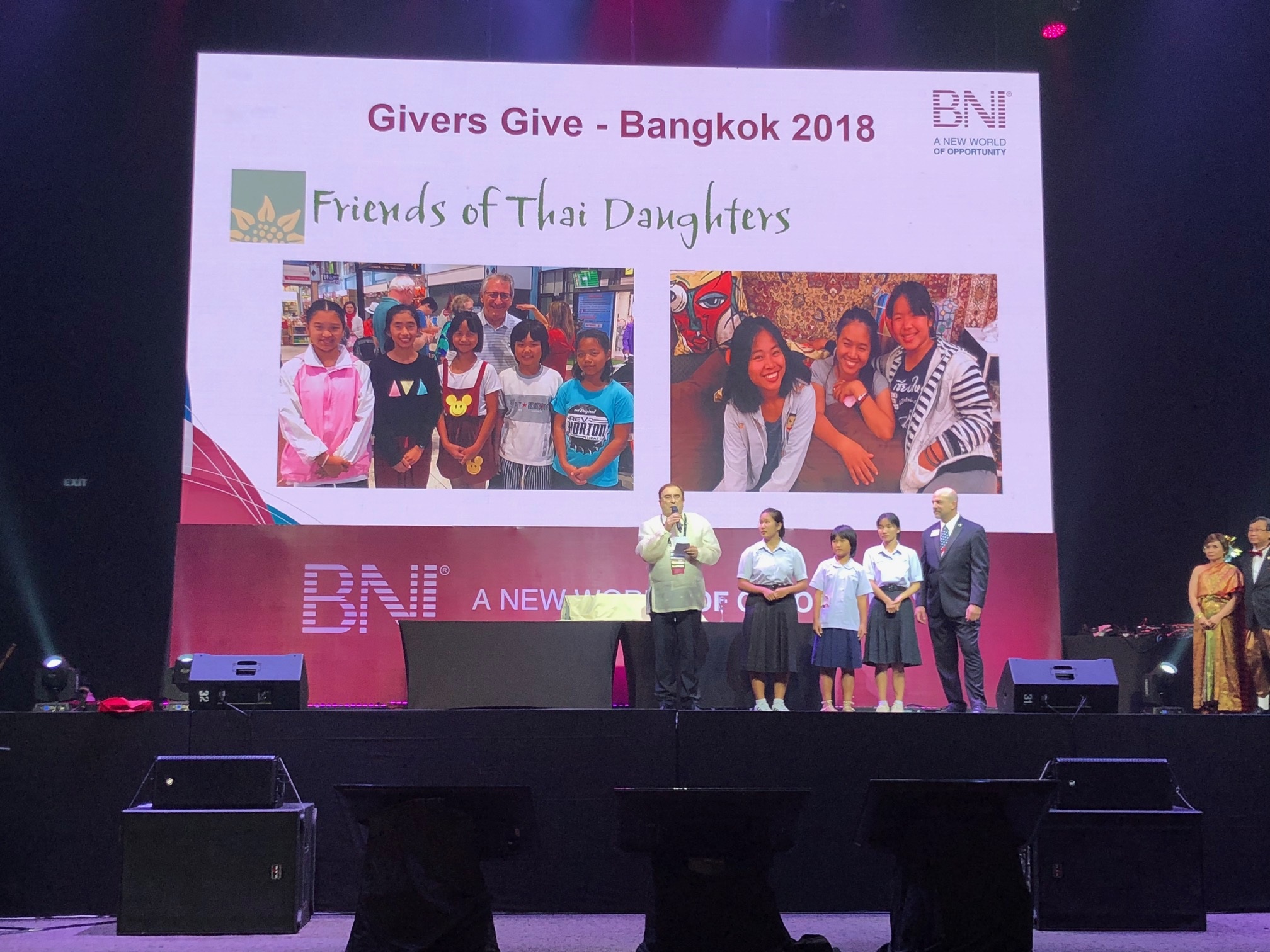
For the first time in our history, BNI?s Global Convention is going overseas. We hope you are planning to join us 7-10 November in Bangkok, Thailand! This year?s event will bring together BNI leaders from around the world ? including BNI Members and Directors ? to learn from one another and share best practices as we work to build the BNI of Tomorrow.
This year there will be a number of new opportunities for all attendees. Of particular excitement is our two-day Members? Event taking place 7-8 November, in conjunction with BNI?s Global Convention for BNI Directors, taking place 7-10 November. We will also be hosting a full trade show open to both Members and Directors alike. One hundred individuals will have the unique opportunity to promote their businesses, and showcase their products and services, to a truly global audience who generate over $13 billion annually. To reserve spot as a trade show exhibitor, register here and select your exhibit booth today.
Until 31 March, we will be offering an early bird registration rate for both the Members Event and BNI?s Global Convention for Directors ($129 for Members, $249 for Directors). If you haven?t already, we encourage you to register today to take advantage of this special pricing.
Email events@bni.com with any questions, and we hope you and your entire family can join us in Bangkok for #BNIGC18 ? it will be an event you will not want to miss!
It’s important to connect and engage with your network via the social media platforms “they” use more than the one’s “you” use. I learned this lesson in a very unusual way.
A few years ago, my children all moved out and were on their own. It soon struck me that I was communicating regularly with them using completely different methods. My eldest, would not respond to emails – ever. She wouldn’t even answer the phone when I called her. I discovered however that when I texted her, she responded immediately. I even tested this once by calling her… no answer. Then I texted her… immediate response. So, rather than try to get her to move over to my preferred platform, I figured that in order to keep a good line of communication open with her – I would mostly text her. It was great. We started talking more (albeit by text).
My second daughter wouldn’t use email, didn’t use the phone (to talk), and wouldn’t consider texting (it was so old school). No, she communicated by “WhatsApp!” Now, I had no idea how to use WhatsApp (I barely know how now). However, my wife pointed out that if I wanted to keep a line of communication open with her – I needed to download WhatsApp. I did. I still have no idea how to use it other than send a text to my daughter whereby she almost immediately responds.
My son didn’t use email, didn’t use the phone (to talk), wouldn’t consider texting, and didn’t use WhatsApp! What was I to do? Then, I realized that he is a big online gamer and he was using a platform called Steam. I also discovered that Steam had an instant messaging feature. So, I downloaded Steam and purchased a game so that I could instant message him. Yes, that’s right, I bought a game so I could talk to my son. As crazy as it sounds – it worked. If I called, emailed, messaged him on any social media platform – I’d get no response. None. However, if I saw him online and texted him – I’d get an instantaneous response! Success.
The bottom line is that if I wanted to communicate with my children, I needed to use their platforms, not mine. Although their platforms have changed over time, this, taught me a lesson in networking. If I want to stay connected to the people I meet through my networking efforts, I need to go where they are – not where I am.
This applies to face-to-face networking opportunities as well as online opportunities. If building a powerful personal network is important to you – go where your connections are – don’t expect them to always come to you.
Called the “father of modern networking” by CNN, Dr. Ivan Misner is a New York Times bestselling author. He is the Founder and Chief Visionary Officer of BNI (www.bni.com), the world’s largest business networking organization.
Back in 2008, I attended my first BNI Meeting in Nashville, Tennessee. I was a manager, but I saw the power and immediately told my father that owns a business in Florida about this global network… fast forward a few years, and my father joined a chapter in the Tampa Bay Area.
Over the years, he went from selling his products at flea markets to nearly 100 percent through BNI referrals. His network really changed his life!
About 3 years ago, I moved back to Florida to begin to take over my dad’s business as he transitions into retirement.
I joined my own BNI group, and the results have been phenomenal. I’ve made the investment into the Ignite Your Business, then turned up the volume even more by enrolling in the Referrals for Life program with Tiffanie Kellog.
I’m writing this to say thank you for all BNI has done. BNI has changed the path of my dad’s life, my life, and my daughter’s life as she is completing her massage therapy schooling and will eventually become a great member to the BNI family.
#BNIForLife
Share your own BNI story with us at successnet@bni.com
Submitted by Claudia Lowry, Executive Director, North & South Peninsula
BNI’s Member Traffic Lights (Power of One Report) and Chapter Traffic Lights are tools that are provided to help members analyse what’s working and what’s not working, and how we can make it better.
This concept is something that all business owners and professionals do in their businesses, usually when strategizing around growth or reviewing a past period.
The benefit of having this tools in BNI is that it becomes a goal setting system, to help members get the most out of their membership.
Solveig McCormick, Administrator at the BNI National Office has shared this analogy with us:
Visualise an aircraft preparing for Take Off.
People buy tickets and arrive for check in. Fuel is loaded and luggage, freight and meals are loaded. Then the people board but as yet it is immobile. There is a flight plan but nothing is happening yet.Refer to this as being in the Grey Zone on the Traffic Lights.
Refer to this as the Red Zone.
Now there is the long climb to reach altitude and set course. A lot is happening. The air crew are hard at work taking care of the passengers and there is positive tension in the cock-pit. It takes a long time to reach cruising altitude. It takes a lot of fuel and have you ever noticed that the stewards and stewardesses are pushing the service trolleys uphill? Or bracing against the gradient from the other direction?
This period of effort is the Amber Zone. (Amber is a warning light. One needs to be aware and cautious to avoid mishap.)
Finally the aircraft reaches cruising speed and the course is set. People relax, they have eaten, start visiting the amenities. Out come the laptops; and in the cock-pit, auto-pilot is set while the flight crew relax a little and have a meal. The co-pilot updates his data.
But we are never out of danger. It takes as much work to stay in the green zone as it took to arrive there. This is where people relax and slip off their shoes and read books and forget for a while about the business of reaching a destination. There could be a storm or some cloud turbulence, or there could be a very slight course deviation that on a flight takes a good deal of correction to avoid intruding on the paths of other aircraft.
I have seen when monitoring the traffic lights that the brightest, the biggest and most sure chapters suddenly hit the slippery slope because they became complacent.
When a plane is into a bit of a nose dive it takes considerable skill and herculean effort to direct it back up again.
Chapters in the Green look like this:
All members arrive early
All members to at least one 121 per week
Members are proud to bring visitors, there are visitors at every meeting.
Members arrange and attend outside chapter events, such as mixers, dinners and regional events
Chapter participates in Business Open Days (Visitor Days)
Members have a supportive and friendly culture
Members exude high energy and a positive attitude
They enforce accountability but still have fun.
Members are making money and have a Givers Gain mindset.