

Get More Business Referrals with One Clear Client Story

When business professionals try to earn more business referrals, the instinct is to explain everything: every service, every type of client, every problem they can solve. More information feels like more chances for someone to spot a fit.
In practice, a long overview tends to blur together. Listeners walk away with a general sense of your business but no clear idea of when someone they know might need you. That leaves them to connect the dots on their own, and most won’t.
The fix is to get specific. One of the easiest ways to do that is to tell a client story.
Client Stories Are Easier to Remember Than a Service List
Most people know what a bookkeeper does. But “I provide bookkeeping services for small businesses” doesn’t tell anyone who needs that help right now.
Compare it with this:
“A business owner came to me because she was spending her weekends catching up on financial records. Her business was growing, but she couldn’t easily see which invoices were overdue or how much cash she had available. We organized her records and set up a monthly process, so now she makes decisions with a clear picture of her finances and gets her weekends back.”
Now the listener has something specific to recognize. The next time a business owner mentions falling behind on invoices or losing Saturdays to paperwork, the bookkeeper comes to mind. A good story connects an everyday conversation to the work you do.
Experience referral networking in action
Get InvitedChoose One Client Example to Focus On
You don’t need an extraordinary success story. A familiar client challenge is often more useful, because it’s something people are likely to run into in their own networks.
Start with one question: What do I want someone to recognize after hearing this?
An interior designer might want people to think of homeowners who feel overwhelmed by renovation decisions. An IT professional might focus on growing businesses that have outgrown their current technology. A commercial insurance agent might explain what happens when a business adds a new service without reviewing its coverage.
Choose one example and build around it. Trying to show every part of your expertise at once makes the main point harder to remember.
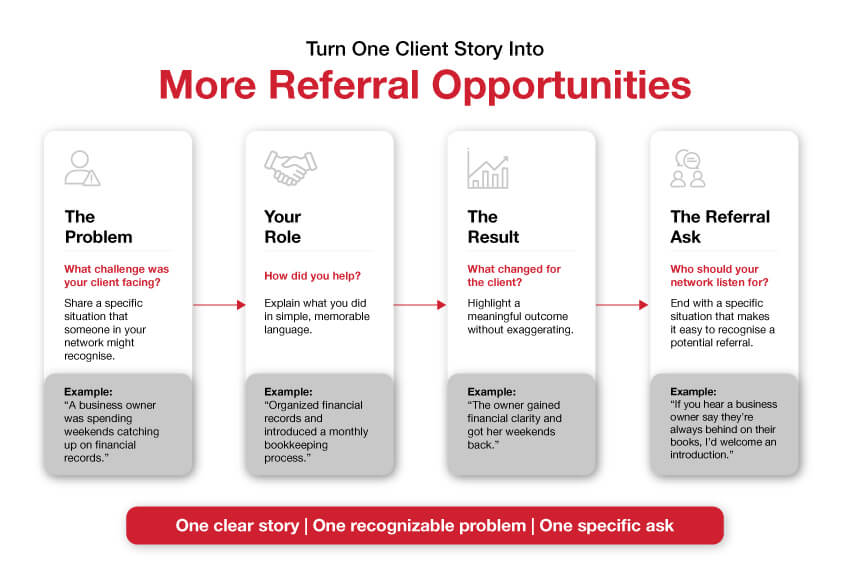
Show the Problem, Your Role, and the Result
A strong client story gives the listener enough context to follow three things: the problem, what you did, and the result. Explain who needed help and why they reached out. Describe your part in plain language. Then finish with the difference it made.
That difference doesn’t have to be dramatic. Time saved, a decision made with more confidence, a smoother process, or a problem solved before it grew are all worth sharing. Be accurate about results and don’t embellish. When you’re describing a real client, get their permission or keep the details anonymous.
Spell Out the Business Referrals You’re Looking For
Even a great story can leave someone wondering who they should introduce to you. Close the gap by ending with the situation you’re looking for, in words your network might hear in conversation.
For the bookkeeper, that might sound like: “If you hear a business owner say they’re always behind on their books or aren’t sure which customers still owe them money, I’d welcome an introduction.”
That’s far more useful than asking whether anyone knows someone who needs bookkeeping. It’s also a habit BNI Members practice regularly. Ending with a clear, specific ask gives the room something concrete to listen for in the week ahead.
Practice Your Story Without a Script
Talking about your business in front of a group makes plenty of professionals nervous, and a memorized script usually adds to the pressure. A client story is easier to deliver because you were there. You know how it unfolded, so you can tell it in your own words and adjust as you go.
Know the key details, then practice saying the story out loud. Cut technical terms that need extra explanation and background that doesn’t help someone spot a referral. If you’re sharing at a networking meeting, keep it within your time.
Using Client Stories in a BNI Chapter
At BNI meetings, Members get a short slot each week to talk about their business with the same group of people. That makes it an ideal place to rotate stories. Instead of repeating the same overview, Members can share a different client example each week, so the room builds a fuller picture of who they help.
Stories carry into one-on-one meetings too, where Members get to know each other’s businesses in more depth. There’s time for the longer version of a story and a conversation about who else might be facing the same problem.
Over time, people stop thinking “she does bookkeeping” and start thinking “she’s the one who helped that owner get her weekends back.” That second thought is much more likely to turn into a referral.
Your Client Stories Are Worth Sharing
It’s easy to assume your client experiences are too routine to be interesting. But your network doesn’t need a remarkable story. They need a clear one, tied to a problem they’ll recognize the next time they hear it.
Start with one client, one problem, and one specific ask. Share a new example each time you talk about your business, and your network’s picture of what you do will fill in over time.
If you’d like to see how Members help each other understand who to refer, visiting a local BNI Chapter is an easy place to start.